
Improve Nursing Home Leadership & QAPI Readiness
Improving Leadership and Quality Improvement Through a Statewide Initiative in Michigan
The Moving Forward Coalition partnered with the Michigan State Long-Term Care Leadership Team, four Michigan nursing homes, a group of local coaches, and national content experts to strengthen leadership and Quality Assurance and Performance Improvement (QAPI) readiness in those Michigan nursing homes over two years (2023–2025). The initiative, generously supported by the Michigan Health Endowment Fund, focused on increasing awareness about leadership fundamentals, QAPI principles, and practical conditions that strengthen teams and improve care. Experts and advisors led regular sessions on communication, trusting relationships, diversity, coaching, managing conflict, teamwork, and translated those priorities into easy-to-use tools and resources to support strong teams and quality improvement.

Why Leadership and QAPI Matter
Strong nursing home leadership is essential to building effective teams and improving older adults and people with disabilities’ quality of life, an emphasis echoed throughout the 2022 National Academies of Sciences, Engineering, and Medicine (NASEM) Nursing Home Report. When leadership supports clear communication, coaching, celebrating achievements, and shared accountability, teams are better positioned to identify problems early, test improvements, and sustain positive change.
QAPI is more than a nursing home regulatory requirement. It is a practical, team-centered approach to building stronger systems, improving clinical outcomes, and creating a more supportive work environment. When done well, QAPI helps staff move from reactive “fixes” to structured prevention and improvement that is measurable, replicable, and embedded in everyday practice. It also enables staff members to fully engage in how the entire organization designs and provides care and support for older adults living in the nursing home.
Why Action Is Needed Now
Many nursing homes want to strengthen QAPI, but teams often face real barriers including limited time, competing priorities, and tools that may feel too abstract or burdensome to use in daily workflows. As a result, QAPI efforts can become compliance‑focused rather than improvement‑focused - which can make it harder to build momentum, engage residents and staff, and sustain progress.
This initiative was designed with national and local advisors and individuals with lived experience to meet nursing home teams where they are by providing simple, step‑by‑step resources that make QAPI more manageable, relevant, and achievable. The goal is practical readiness: helping teams build the confidence and structure needed to design and lead effective performance improvement work, including data collection and analysis. Mission-driven QAPI programs go beyond just completing federal requirements.
From Design to Real World Testing and Implementation
How statewide collaboration shaped new leadership and QAPI resources
Over the past two years (2023–2025), we worked with four Michigan nursing homes, a team of Michigan‑based coaches, and national content developers to test what helps teams build leadership and QAPI skills in real‑world conditions. This approach blended on‑the‑ground practice with expert input, and the results are based on what teams need: clear language, practical examples, and tools that support communication, teamwork, data management, and structured improvement.
Michigan-based expert coaches worked directly with nursing home leadership teams throughout the project. Coaches met regularly with each site to review progress, troubleshoot barriers, and help teams implement the leadership and QAPI resources in operational settings. Coaches helped teams translate concepts into practice by facilitating discussions, guiding data review, and supporting the design and testing of Performance Improvement Projects (PIPs), This coaching relationship created space for teams to reflect on challenges, celebrate progress, and build confidence in leading improvement work within their own organizations.
Putting Principles Into Practice
How nursing homes used the Michigan leadership and QAPI resources with structured support
The Coalition updated the LeadingAge NurseLEAD leadership program and developed QAPI resources through collaboration with Michigan nursing home teams, coaches, and colleagues. The two sets of materials are designed to give nursing home leaders and staff streamlined, usable tools that promote leadership and QAPI.
Together, the NurseLEAD leadership program of modules and the QAPI workbook, companion education slides, videos, and supporting tools walk teams step-by-step through the essential elements of effective performance improvement.
Nursing home teams used those resources to identify improvement priorities within their own organizations and to design Performance Improvement Projects that addressed operational and clinical challenges. Examples of improvement efforts included strengthening communication across shifts, improving consistency in care processes, and developing clearer systems for tracking quality indicators. The structured approach helped teams move from reacting to problems toward testing solutions in an intentional and measurable way.
The tools are intended to help nursing home teams:
Build shared understanding of QAPI principles with the interprofessional team
Strengthen collaboration and teamwork through structured improvement processes
Develop confidence and practical skills to lead and sustain leadership and QAPI principles during daily work with older adults
Integrate leadership and QAPI into daily operations
Key leadership and QAPI Documents and Tools
NurseLEAD leadership education and implementation program
QAPI Workbook: A practical, step-by-step workbook that guides teams through the core components of QAPI, from setting aims and conducting surveillance to launching and sustaining Performance Improvement Projects (PIPs).
Advanced QAPI Resource Guide: An expanded set of tools and references for teams looking to deepen their QAPI practice, strengthen existing systems, or tackle more complex improvement challenges.
Educational Slide Decks
Performance Improvement Projects (PIPs): Facilitated training slides that help teams understand, design, test, and refine PIPs using structured improvement methods and real world examples.
QAPI Regulatory Requirements: A clear, accessible overview of federal QAPI requirements, designed to help teams understand expectations and align improvement efforts with regulatory standards.
QAPI Session 1 (QAPI Overview): Introduces the purpose, core principles, and structure of QAPI, establishing a shared foundation for leadership and staff.
QAPI Session 2 (Surveillance): Focuses on identifying and monitoring key quality indicators to spot improvement opportunities early.
QAPI Session 3 (Interpreting the Data): Builds team skills in using data to guide decisions, prioritize improvement efforts, and track progress.
QAPI Session 4 (Committee & Wrap‑Up): Supports effective QAPI committee function, clarifies roles, and outlines next steps for sustaining improvement over time.
Importantly, this work engaged interprofessional teams that included nurse champions, administrators, direct care staff, and quality leaders. The process helped broaden participation in quality improvement discussions and gave staff members practical ways to contribute ideas and observations from their daily work with residents. Over time, teams reported growing confidence in their ability to organize improvement work and engage colleagues in the process.
From Practice to Continuous Learning
How implementation experience strengthens leadership and QAPI readiness
These resources are meant to remain useful long after the project period ends—supporting ongoing collaboration, continuous learning, and sustained QAPI readiness and program implementation as teams grow and adapt.
Michigan’s experience also highlights the value of pairing practical improvement tools with coaching and peer learning opportunities, creating conditions where teams can build leadership capacity while actively testing improvements in their own nursing home.
From Learning to Policy
How Michigan’s experience informs broader quality improvement efforts
What we learned from this Michigan initiative contributes to broader understanding of what nursing homes need to strengthen leadership and implement QAPI in ways that are realistic and sustainable. Implementation lessons inform future quality improvement investments, training and coaching programs, and approaches that make QAPI more actionable for teams across diverse settings.
Nursing Home Leadership and QAPI Resource Repository
For more information on how to Improve Nursing Home Leadership, please click here. You will be directed to the LeadingAge NurseLEAD webpage to learn more about the NurseLEAD program.
For more information on Nursing Home QAPI Readiness, please scroll to the resources below.

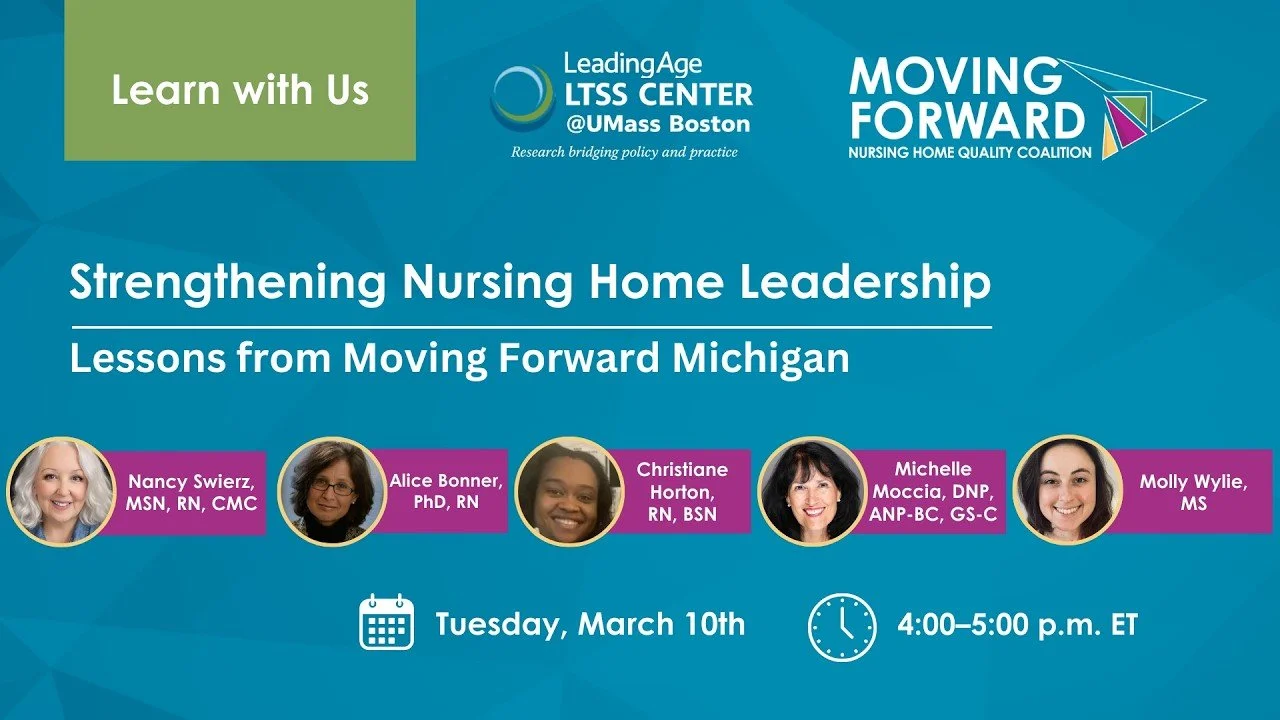
This webinar shares lessons from the Moving Forward Michigan initiative, which tested a practical, affordable model to strengthen leadership capacity and QAPI efforts in under-resourced nursing homes facing ongoing workforce and operational challenges. Drawing on real-world implementation and evaluation, it highlights the critical role of coaching, along with tools and strategies that can be adapted to support quality improvement in other settings.
Nursing Home Leadership and QAPI Resource Repository
Thank You
We gratefully acknowledge the contributions of Michigan nursing home teams, coaches, the Michigan State Leadership Team for Long-Term Care, and national advisors in producing and updating program resources. We also thank LeadingAge for producing and updating content in the NurseLEAD program and Superior Health Quality Alliance in co-developing the QAPI materials.
This project was generously supported by the Michigan Health Endowment Fund.